A 30-DAY CHALLENGE

You were the one they blamed when something went wrong β€” even when it wasn't you. The one compared to the sibling who could do no wrong. You learned to brace before you walked in the door, to apologize before you'd even spoken. And somewhere along the way, you started to believe them: that you really were the difficult one.

For the one who was cast as "the difficult one," "the too-much one" β€” while a brother or sister got to be the golden child.

The night my sister asked why I always make it about me, I had an answer forty years in the making.↓

"Why do you always make it about you?" my sister said, and the whole table went still in that particular way β€” the way that means everyone already agrees with her. I was forty-one years old. I had said, out loud, that I'd found the last few Christmases hard. That was the whole crime. Making it about me.

I apologized, of course. I'm very good at apologizing. I've had a lot of practice.

You have to understand I'd been in training for this since I was small. In our house there was a golden child and there was me, and the casting was done early, before I had any say in it. My brother could set the curtains on fire and it was a funny story we still tell. I could get a B-plus and it was, somehow, a conversation about my attitude. I was "the sensitive one," which is the word families use for a child who notices things they'd rather she didn't.

So I did what the difficult one does. I overcorrected. I brought the good wine and remembered which cousin wasn't speaking to which. I laughed at the joke that was, on close inspection, about me. I kept a kind of ledger in my head β€” proof of my own decency, evidence I could hand over the day someone finally asked whether they'd gotten me wrong.

Nobody asked. That's the part I couldn't get anyone to understand. It wasn't cruelty, exactly. It was a role, and the role had been assigned, and everyone kept reading their lines.

I was "the sensitive one," which is what families call a child who notices things they'd rather she didn't.

The bottom, when I finally saw it, was in my pocket. It was the family group chat β€” that cheerful, relentless thread with the confetti emojis. My cousin got engaged and it lit up for two days. My brother's dog had a limp and there were nineteen replies. When my niece was born I refreshed it for an hour like an idiot, watching the little bubbles bloom. And then I posted, once, that I'd gotten a promotion I'd worked three years for. Two hearts. My mother's, and mine. Then the thread moved on to whether Aunt Viv was bringing the trifle.

I sat there and I did the math I'd been avoiding my whole life. It wasn't that they hated me. It was quieter and worse than that. In the economy of that family, my good news simply didn't convert. It never had.

What actually shifted things wasn't a confrontation. It was a shoebox. I was clearing out a cupboard and found the birthday cards β€” years of them, kept for no reason. And I started reading. My brother's from our mother: whole paragraphs, jokes, exclamation marks, my darling boy. Mine: signed, dated, correct. Love, Mum. The handwriting told a truth that forty years of dinners had trained me to explain away. One of us had been written to. The other had been recorded.

I want to be clear that nothing dramatic happened next. I didn't confront anyone. I didn't send a searing text. What I did was smaller and stranger β€” I got a notebook, and for ten minutes most mornings, before the day could talk me out of it, I wrote down the plain difference between what happened at a given dinner and the story I'd been handed about who I was in it. Some mornings they matched. Most mornings they did not, and seeing the gap in my own handwriting was harder to argue with than any sister across a table.

I'd love to tell you I stopped apologizing overnight. I did not. I over-explained on the phone and heard myself doing it. I rehearsed one firm sentence for a week and then said "sorry, ignore me" instead. But slowly I stopped filing my defense with people who were never going to read it. I set one small limit and I survived their disappointment, which turned out to be survivable. Then another. I got a little quicker at catching the old flinch, and a little kinder to the girl with the B-plus who still lives in me and still thinks she's about to be found out.

I'm not cured, whatever that would even mean. I still brace at the door some visits. I still feel the old tug to make myself smaller in the hallway. What's different is that I finally know whose story "the difficult one" was β€” and that a part someone else wrote for me is a part I'm allowed to hand back, no dramatic exit required.

If you're the one they shake their heads about β€” if you rehearse before every call and apologize for taking up a chair β€” I want to say the thing no one said to me at that sink of a group chat. You were not too much. You were the one in that family who was willing to say the quiet part out loud. That's not a defect. That's the whole reason they needed you to be the problem. Set it down. It was never yours to carry.
Does this sound like you?

You rehearse what to say before every family call.
One sibling gets forgiven everything. You get forgiven nothing.
You've said sorry so often you barely know what for.
Deep down, you half-believe you really are the difficult one.
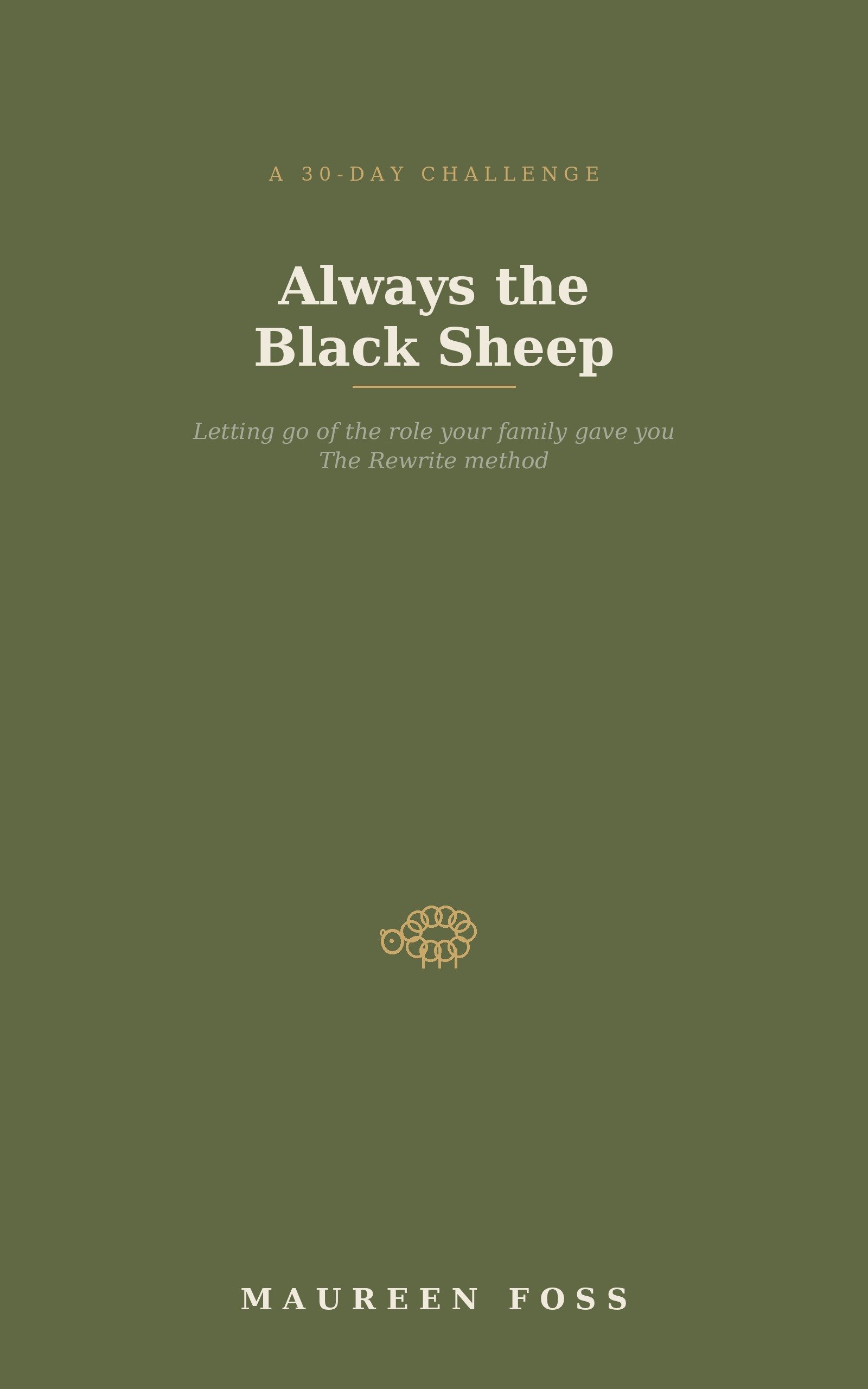
$17Always the Black Sheep
THE WORKBOOK

So I turned those mornings into thirty of them, for you

The shoebox and the notebook did more than any dinner ever did. So I shaped what worked into thirty short mornings β€” one honest read, one small step, room to write by hand β€” for the one who was cast as the difficult one while a brother or sister got to be golden. It isn't therapy. It's a companion, written by someone who kept the cards and finally read them.

  • 30 days, one at a time β€” no overwhelm.
  • One realistic step a day, with room to write.
  • Written by someone who lived it, not a cold manual.

Less than one hour of a therapist's time β€” for thirty mornings that quietly take the role off your shoulders.

βœ“ 30-day guarantee β€” full refund, no questions asked

Secure checkoutInstant downloadFill-in workbook30-day guarantee

What you get

Everything inside your 30-day workbook

Thirty mornings, ten minutes each

Each day: a short honest read, one small step for today, and a few questions with real space to write by hand. No lectures, no homework pile β€” one day at a time, at your own pace.

A pact you sign on day one

A short, plain promise to yourself β€” not to go no-contact, not to win any argument, just to stop auditioning for a part you never chose. You date it and sign it, so future-you can hold present-you to it.

Your own script, in your own hand

A fill-in page near the end to name who you actually are β€” apart from 'sensitive,' 'too much,' 'the difficult one' β€” so the last word on you is finally yours.

Day 27, for the serious stuff

One quiet day that gently separates an unfair family role from real abuse, or a depression that needs more than a notebook β€” and points you plainly toward where to get help.

A printable PDF, honest about the ending

Read it on a screen or print it and scribble in the margins. No fairy tale, no pretending you'll never feel fifteen at that table again β€” just catching it sooner, and being gentler when you do.

What one day inside looks like

DAY 7 Β· AN ORDINARY DAY
  • A short, two-minute read that doesn't lecture you.
  • One single step for today. Small on purpose: it fits your worst day.
  • Room to write it in your own hand. Your words, your pace.

How the 30 days work

Week 1

Read the casting call: how you got assigned 'the difficult one' before you could vote

Week 2

Follow the payoff: what the family actually got out of having a black sheep

Week 3

Hand back the blame: stop filing a defense with people who won't read it

Week 4

Write your own part: who you are apart from their verdict

Who wrote this

R

By Ruth Calder

I'm Ruth Calder. I still have the shoebox of birthday cards β€” I keep it on the top shelf, next to a jar of buttons my grandmother left me β€” and reading those cards, years apart in a cold cupboard, was the day the story finally cracked. The role was never mine. It was handed to me. And a handed-down role can be handed back.

Our deal with you

  1. We won't tell you that in 30 days you'll be cured. It doesn't work that way, and you know it.
  2. No invented testimonials, no fake countdowns, no "only 3 left".
  3. If you open the workbook and it doesn't speak to you, I'll refund you. No questions, for 30 days.
This is companionship, not therapy, and doesn't replace help from a professional. If you or someone is in danger, get help: in the US, 988 (crisis) and, in an emergency, 911. If there's abuse, the National Domestic Violence Hotline 1-800-799-7233. And if the pain has become constant, talk to a psychologist.

Frequently asked questions

Is this therapy?
No. This is one woman's honest experience, not treatment. It's a warm companion for 30 days β€” a place to think, write, and set things down. If the wound runs deep, or you're carrying real depression, this walks beside a good therapist; it doesn't replace one.
Do I have to cut off my family to do this?
Not at all. This isn't a book about going no-contact. It's about putting down a role you never chose, so you can decide β€” calmly, on your terms β€” how close you actually want to be. Some readers grow closer. Some step back. Both are allowed.
Won't this just make me angry at my family?
It's not about building a case against them. It's about handing back a blame that was never yours to carry, and stopping the exhausting job of defending yourself to people who aren't really listening. Less anger, in the end β€” not more.
What actually happens in the 30 days?
Ten quiet minutes a day. A short, honest read, one small step for today, and a few questions with room to write by hand. No lectures, no homework pile β€” just one day at a time, at your own pace.

Start today. One day at a time.

You were never the problem. You were the one who told the truth.

βœ“ 30-day guarantee β€” full refund, no questions asked

Get the free 1-page guide

Leave your email and I'll send it right now. Β«5 Phrases to Set a Boundary Without Burning the BridgeΒ»

I'll send you the guide and, now and then, something that might help. No spam; unsubscribe anytime.

This is companionship, not therapy, and does not replace help from a professional.

$1730-day guarantee β€” full refund, no questions asked
I want the workbook